 Sarah Wray: My Tenth Anniversary
... I must tell you about my husband. He is a wonderful man. And I don't say that just because our tenth anniversary was last week. He really is wonderful ...
Sarah Wray: My Tenth Anniversary
I'm closing out this topic today with points 4 and 5--R for Reaction and K for Knowledge. I remind you again that these workshop notes are rather cryptic. Neither are they meant to cover every possible point, and every possible exception to all those points. This was only an hour-long workshop. (That enough disclaimers, you think?) So take from this when you will.
4. REACTION: This has to do with the constant building of suspense through your character’s reactions. SOMEBODY’S got to be proactive in his/her reactions, whether it’s your protagonist or antagonist.
Example: your character is out walking the dog at night and witnesses a murder. She runs away, planning to tell no one so she won’t be involved. But the murderer sees HER and vows to silence her. He’s the proactive one. In this kind of cause-and-effect reaction, the protagonist keeps trying to back off from the situation while the antagonist keeps the situation tightening.
Or, your character can react proactively from the start. She can feel she doesn’t want to be involved, but her conscience drives her to report the crime. Her thought is: this is all I’ll have to do, then I’ll be done with it. She reports the crime and solves the problem of her conscience.
Now you’ve got the proactive cause-and-effect. Next thing your character knows is – she’s drawn in a little deeper. She thinks, I’ll just have to do “B”, then I’ll be done with it. She does “B.” And before you know it, “C” arises.
Little by little, reaction by reaction, she is pulled deeper and deeper into the suspense, even while thinking that with just one more step, she’ll get out of it. In other words – the solving of one problem simply leads to another, worse one.
You can blend these two types of reactions. Your character may be proactive at first, then get so tired of the situation, she tries simply to run. But at that point, you’ll have to make other characters the proactive ones so that for her, there’s no escape.
The main thing, keep that screw tightening. Keep it tightening.
5. KNOWLEDGE. This refers to two types of knowledge: (A) the knowledge you allow the reader to have, and (B) the knowledge you withhold by planting questions in the reader’s mind. One leads naturally to another.
A. Knowledge you allow the reader to have. This aspect goes hand in hand with Pace. Because pace must be swift, you cannot allow the story to stop for long in order to introduce backstory. Especially in the beginning of your novel – keep backstory to a bare minimum. Start with action.
B. Planting questions in the reader’s mind. This requires a deliberate releasing of tiny bits of information – starting in your very first scene. Questions increase suspense. They are what keep your reader turning pages.
Points A and B both need to be used at the same time for ultimate suspense. Excess backstory can deaden any kind of novel, and should be avoided. Backstory should be spread out over time, told to the reader only on an as-need-to-know basis. HOWEVER, in suspense, rather than eliminating backstory completely in a scene, you add just a taste of it.
Example of Point A used alone (no backstory): A novel begins with a man going into a bar in a strange town. He sits down, orders a drink. A group of huge, mean-looking guys immediately surround him, spoiling for a fight. He doesn’t want to fight, but he has to. The scene is pure action, not stopped by any backstory regarding who this guy is. The level of suspense = will he win the fight? Obviously, that question is answered at the end of the scene.
Example of Points A and B used (tiny bits of backstory added to raise questions in the reader’s mind): Same scene. This time, as the bad guys surround the protagonist, this narrative is added: Not here, not now, he thought. How could they possibly know who he was? Through how many towns, how many states would he have to run?” Then the bad guys strike, and it’s back into action as he fights.
These three sentences are not enough to slow pace. In fact adding them heightens the level of suspense. Now, the reader’s questions are far more than who will win the fight. The reader will wonder: Why is this guy running? Who is he? What kind of reputation is this that causes strangers to fight him? How many towns and states has he already run to? When will he be able to stop? Etc. These questions are NOT answered at the end of the scene. They will keep the reader turning pages to find out the answer.
Bottom line, suspense is all about keeping those pages turning.
Speaking of which, I'm having a heck of a time writing my current one. I've hit that snag place, you know? I know I'll work through it, but...ugh.

Wilbur: Celery and the Wasp
...His grandpa's name was Fitzgerald P. Cellaway, but he preferred to be called Celery, so we all did. Celery and I were driving down Main Street one day when a wasp flew in the window and landed in his hair. The man got real agitated, swatting everywhere. I had to grab the wheel to keep us from going off the road.
"Where’d it go?" Larry yelled.
I couldn't see the thing anymore. "It must have flown out the window."
But that wasp hadn't gone anywhere. Turns out, that evil critter followed south down the path made famous when a plumber bends over. All the sudden Celery got wide eyed. He let go of the wheel, stepped on the brakes and grabbed his backsides with both hands...


Over the next few days I’m going to run the notes from my workshop given at the recent ACFW (American Christian Fiction Writers) Conference. The topic of the workshop was on inserting suspense elements into a novel. Any genre of novel.
Obviously different kinds of stories will call for different levels of suspense. Many of these notes are referring to pure suspense. But the point is to look at the elements that make a suspense story and see how you might use them to some extent in your own work. Why? Because suspense elements make the story more interesting. If suspense has one thing going for it, it’s that these stories present a higher level of stakes. High stakes lead to a strong driving question that will propel readers through the book. (I’ve read—or started to read—way too many stories in the past year that didn’t present a strong enough driving question to make me stick with the book to see how it ended.)
So take from these cryptic notes what you will. If you have questions or want something fleshed out more, just stick ‘em in the comments section, and we’ll deal with them later. And as usual, the comments section is also the place to throw your tomatoes, should you think I’m totally off the mark.
Here goes:
----------------------------
What is suspense? A story with a high level of tension, founded on fear for the character’s welfare.
This fear doesn’t have to be about the character’s PHYSICAL welfare, necessarily. Life and/or limb doesn’t have to be at stake. Suspense can also focus on the PSYCHOLOGICAL or EMOTIONAL welfare of a character. Many times the stakes are both physical and psychological.
When you think “suspense,” think “SPARK.” SPARK = Stakes, Pace, Aura, Reaction, and Knowledge. These all interact with one another. They simply can’t be separated.
1. STAKES. As suggested by our definition of suspense, a character must have more to lose, whether physically or emotionally, than in other stories.
Example: In my (women’s fiction) novel Cast A Road Before Me, Jessie wants to leave the tiny town of Bradleyville and return to the city, where she can follow in her (deceased) mother’s footsteps. Her overall Desire that pulls her through the story is: to enjoy a quiet summer in Bradleyville, then leave to pursue her mother’s footsteps of serving the poor.
In a general mainstream story, Jessie’s stakes might be all sorts of emotional problems with people that keep her summer from being quiet. Further, they might be issues that arise that could keep her from leaving town as planned.
With the introduction of a suspense element, her stakes rise dramatically--a step at a time.
First, she faces the loss of a quiet summer due to an impending strike at the saw mill, which employs half the town's men. Jessie refuses to have anything to do with the strike. She is a die-hard pacifist.
Then she realizes the strike could lead to violence.
Someone could really get hurt.
Maybe even killed.
In fact, that someone may be very close to her.
At a pivotal moment she realizes to her horror that SHE is the only person who might be able to stop what’s about to happen.
As a result, she finds HERSELF in the very center of the striking mob...
Tomorrow—Pace.


Last July in my report of the ICRS convention, I told you about talking to various people in the Zondervan suite about this project. How excited they were to be working with the Inspired By...Media Group. This project was not Zondervan's idea. It came straight from the Media Group in Hollywood, who wanted to produce a "visceral" Bible experience. They approached Zondervan with their proposal--and the project was born.
This will be an awesome and moving Christmas present for someone.
For more information on The Bible Experience and for links to numerous articles about its production and cast, visit this page on the Zondervan Web site.
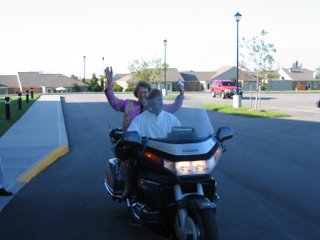
 Naturally, Mom jumped at the chance. No matter that she was wearing a dress--she just hiked it up and climbed aboard. And off they went for a lap around the retirement village.

 Angie Brendt: Pie to the Sky--Part 2


Photo: Mom parasailing at age 84.



